
Yesterday Anthropic released Claude Managed Agents into public beta. I spent the whole day digging through the docs, the engineering blog, the competitive landscape. By the end of it, I realized something had quietly shifted in my head.
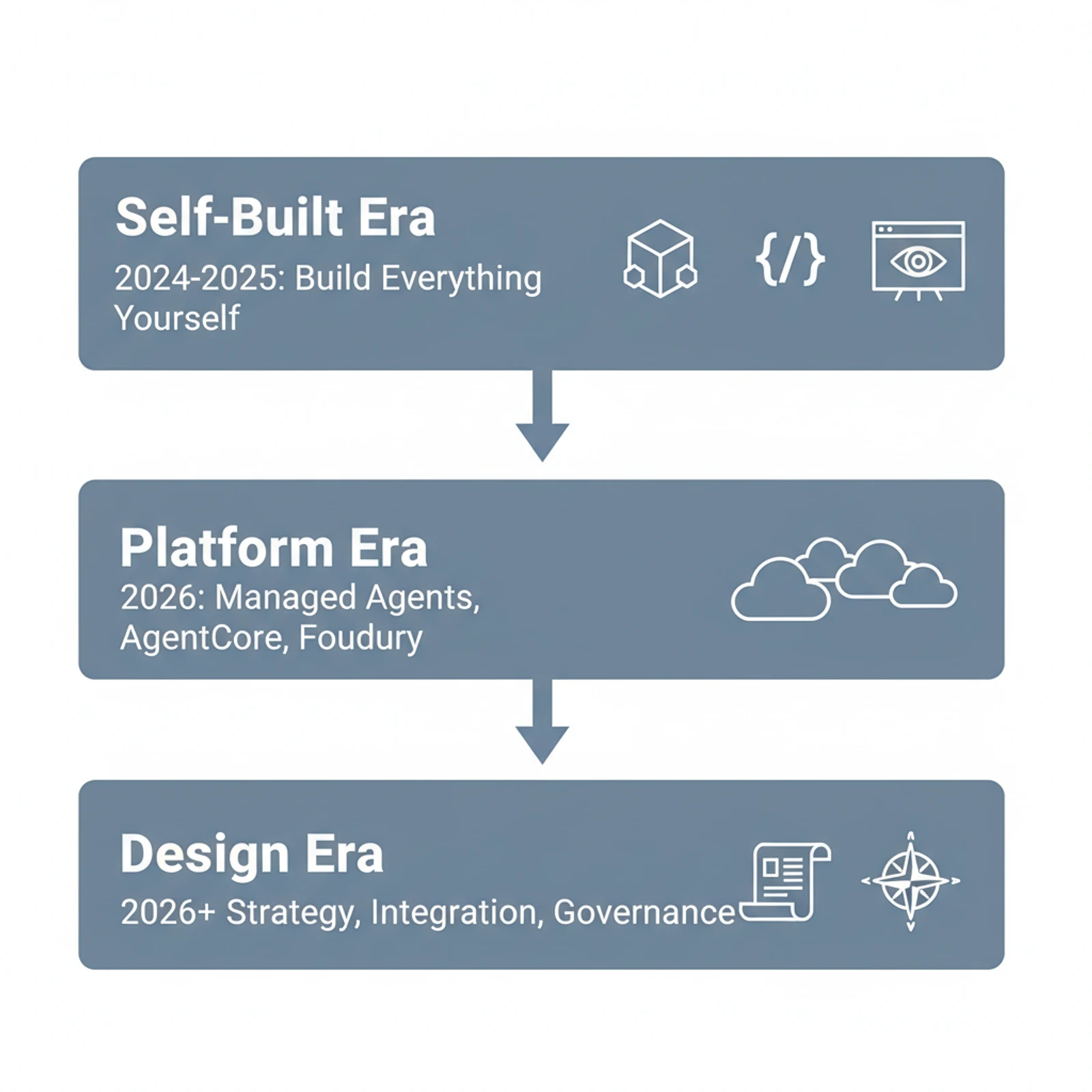
I'm not thinking about how to build agents anymore. I'm thinking about how to design them.
That sounds like a small difference. It's not.
The Infrastructure Layer Just Got Swallowed
Here's the short version of what Managed Agents does: you describe the agent you want — model, system prompt, tools, MCP servers — and Anthropic runs it in their cloud. Sandboxed containers, persistent sessions, credential vaults, 24/7 uptime, auto-scaling. You don't manage any of it.
The architecture is clever. They split the agent into three independent pieces — the brain (Claude + scheduling), the hands (sandbox + tools), and the memory (append-only session logs). Any piece can crash without killing the others. Credentials live in a vault outside the sandbox, so the AI never touches your tokens directly.
Eight SDKs. REST API. $0.08 per session-hour on top of regular token pricing. A typical one-hour coding task costs about 70 cents.
If you've been building agent infrastructure from scratch — setting up Kubernetes pods, writing orchestration logic, managing container lifecycles, handling state persistence — this is your "AWS moment." The thing you spent months building just became a commodity service.
I've seen this before. We all have. It happened with servers. It happened with databases. It happened with CI/CD. The bottom of the stack always gets swallowed eventually.
But I'm Still Building Wheels. On Purpose.
Here's where it gets nuanced, and where I disagree with the simplest version of the "just use managed platforms" argument.
I've been building my own agent harness for months. Custom skills, custom MCP servers, custom orchestration. If you've read my earlier posts, you know the story — I built an OpenClaw knockoff in my living room, I debugged a sixteen-hour death loop caused by three update managers fighting each other, I wired up Telegram bridges and browser automation.
Why would I keep doing that when Anthropic is now offering to do it for me?
Because there's a difference between individual exploration and enterprise deployment.
For individuals and small teams, building your own agent stack is how you learn. You can't design a good agent architecture if you've never felt the pain of a bad one. You can't evaluate Managed Agents versus LangGraph versus AWS AgentCore if you haven't gotten your hands dirty with at least one of them. The wheel-building isn't wasted effort — it's the training data for your own judgment.
But here's the catch: you can't spend six months on it.
Look at projects like Hermes — an open-source agent that teaches itself, learns from its own mistakes, gets better over time. It's fascinating work. It pushes the boundary of what a self-improving AI agent can do. But it's fundamentally a personal tool. One person's agent getting smarter for one person's use case.
Enterprise is a different animal. Enterprise doesn't need an agent that slowly self-improves through trial and error. Enterprise needs agents that work reliably on day one, scale to hundreds of users, and come with SLAs. The Hermes approach — patient, iterative, individual — is great for exploration. Managed Agents is built for deployment.
And the model manufacturers will always catch up. A colleague's insight stuck with me: building a local harness is somewhat futile, because as the model iterates, it solves the very problems your harness was designed to work around. The model's limitations? The manufacturer knows them best. They design the harness to fit, then ship it as a package. That's exactly what Managed Agents is — Anthropic built the harness that fits Claude perfectly, because they know where Claude is strong and where it needs guardrails.
So yes — keep building wheels. But build them fast, learn what you need to learn, and be ready to throw them away when the platform catches up. Because it will. And it's getting faster every time.
Speed Is Everything Now
This is the thing that keeps hitting me. The speed of this industry is genuinely disorienting.
I wrote a post about configurable AI agents in February. Two months later, half the landscape has changed. New platforms, new protocols, new pricing models. If I'd spent three months writing that post instead of two weeks, the conclusions would have been outdated before I published.
The same applies to enterprise strategy. I've watched companies spend six months evaluating which agent framework to adopt. By the time they decided, two of the candidates had been deprecated and a new category had emerged.
For enterprise, this creates a real problem. Traditional technology adoption follows a pattern: evaluate, pilot, build, scale. That cycle used to take 12-18 months. In the agent space, 12 months is an eternity. The platform you chose in January might be fundamentally different by July.
The companies that will lead in AI aren't the ones with the best initial architecture. They're the ones with the fastest turnaround — the ability to evaluate quickly, pilot quickly, learn quickly, and pivot when something better appears. Quick doesn't mean reckless. It means structured speed. Two-week spikes, not six-month evaluations. Parallel experiments, not sequential waterfall.
If you're still writing a 40-page RFP for your agent platform selection, I have bad news. The answer will be wrong by the time the committee approves it.
Vertical Barriers Are Real — But the Clock Is Ticking
One thing I keep hearing from people in specialized industries: "AI agents can't handle our domain. Finance is too regulated. Healthcare data is too sensitive. Our legacy systems are too complex."
They're right. Today.
But the walls are getting thinner every quarter. MCP gives agents a standard way to connect to any system with an API. Skills give agents domain expertise that can be packaged, shared, and iterated on. Managed Agents handles the infrastructure and security baseline that used to be a blocker.
The verticals where agents genuinely can't operate today — the ones with strict data residency requirements, air-gapped networks, regulatory constraints that require human-in-the-loop at every step — those will hold for a while. Maybe a year. Maybe two.
But the verticals where people think agents can't operate, because the last time they tried was with GPT-3.5 and a basic RAG pipeline? Those barriers are already falling. The agent that couldn't navigate your ERP system six months ago might handle it fine now, because the model got smarter, the tools got better, and someone built an MCP server for SAP.
If your competitive advantage is "our domain is too complex for AI," that advantage has an expiration date. The question is whether you'll be the one who brings AI into your domain, or whether someone else will do it first.
The Consulting Revolution Nobody's Talking About
This is the part I find most interesting, because it's the part that affects me directly.
I work with enterprise clients on AI and data projects. The old consulting model was simple: client has a problem, consultant brings expertise and manpower, consultant builds the solution. Value was in knowing how to build things.
That model is cracking.
Here's what I see now: clients are using Claude, ChatGPT, Copilot — directly. They're generating architecture diagrams, writing code, creating documentation. And they're getting better at it every month. The output isn't perfect, but it's often 70-80% of what a consultant would deliver. Sometimes more.
So what do they actually need from us?
Not the hands anymore. They have AI hands. What they need is the head.
They need someone who can tell them: this architecture diagram your AI generated? The data flow is wrong here, and you'll hit a scaling wall in six months. This agent strategy? It looks good, but you're missing the governance layer and your compliance team will block it. This MCP server design? It works, but there's a simpler pattern that three other companies in your industry already validated.
The value has shifted from production to confidence. Clients can produce content, code, designs faster than ever. What they can't produce is the certainty that they're on the right track. They can't produce the pattern recognition that comes from seeing twenty similar projects across different companies. They can't produce the design thinking that prevents expensive mistakes six months down the road.
Best practices. Guidelines. Architectural patterns. Strategic framing. Risk identification. This is where consulting value is concentrating. Not in building — in designing.
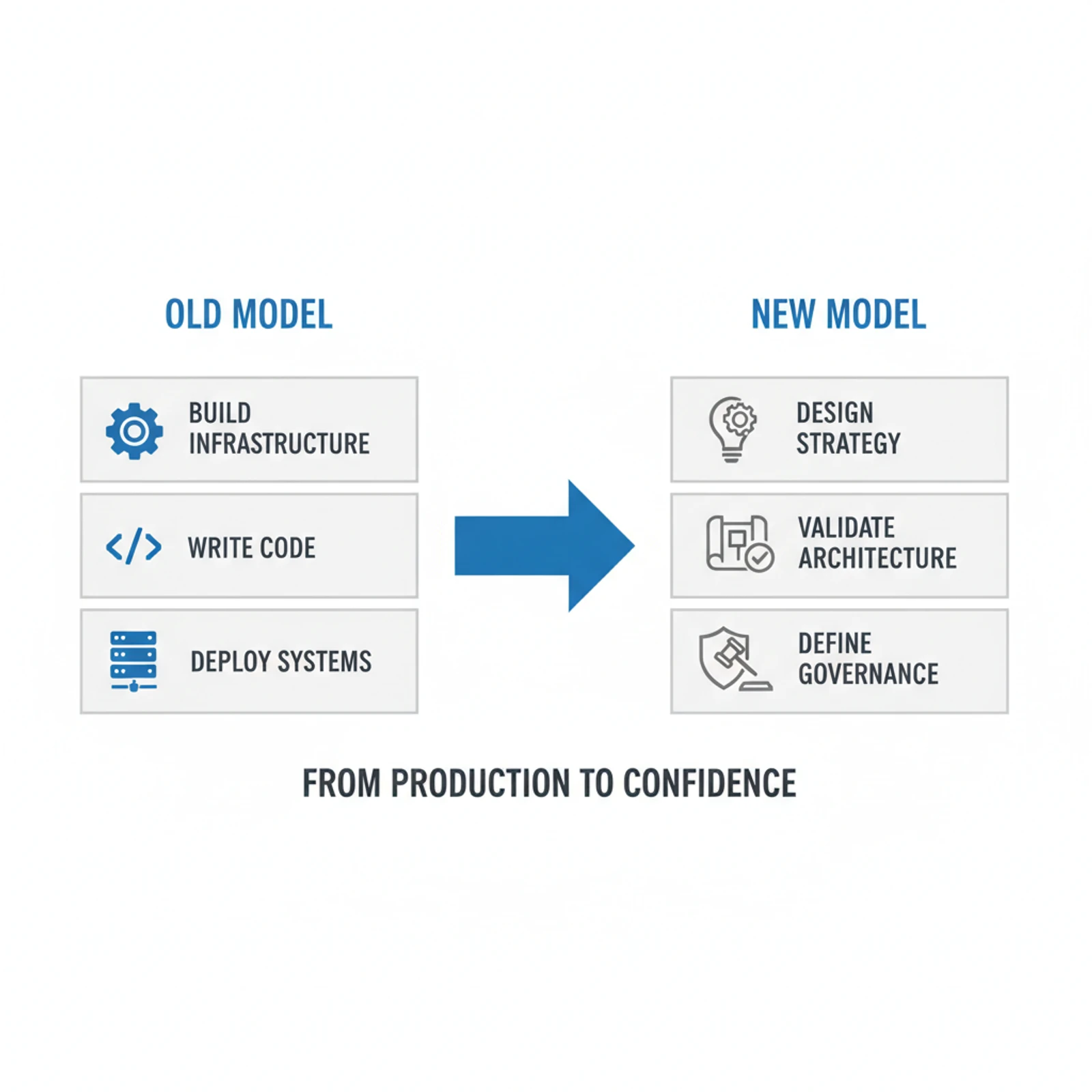
It's the same shift I described at the top of this post, but applied to an entire industry. From building to designing. From execution to judgment.
If you're a consultant still selling implementation hours, the margin pressure is coming. It's not here for everyone yet, but it's visible on the horizon. The consultants who thrive will be the ones who sell clarity — the ability to look at what AI generated and say, with earned authority, "this is good" or "this will break."
The Future Is a Fog
I want to end with something honest.
I don't know what this industry looks like in 18 months. I don't think anyone does.
The numbers are staggering. Anthropic went from $10 billion ARR in January 2025 to $300 billion in April 2026, surpassing OpenAI. The AI agent market is projected to grow from $118 billion to $2.5 trillion by 2034. When the SaaSpocalypse hit in February, $1 trillion in software market cap evaporated in a single quarter. Then it started recovering. Then new products launched that made the recovery feel premature.
Every prediction I've made in the past year has been partially wrong. Not completely wrong — the directions were mostly right. But the speed was always off. Things I thought would take two years happened in six months. Things I thought were stable turned out to be transitional.
So I hold two feelings at the same time, and I think most people in this space do too.
There's fear. Real, grounded fear. The kind you feel when the ground moves under your feet and you realize the skills you spent a decade building might not be the ones that matter in three years. When you see a managed platform replicate in weeks what took your team months. When a client shows you something their intern built with Claude that's actually... pretty good.
And there's hope. The kind that comes from realizing that every technology shift creates new roles, new needs, new value. The cloud didn't kill infrastructure engineers — it turned them into cloud architects. Mobile didn't kill web developers — it created an entirely new category. AI won't kill consultants or builders — but it will change what building and consulting mean.
The fear and the hope aren't contradictory. They're the same signal, seen from different angles. The world is changing fast enough that both outcomes — the one you're afraid of and the one you're excited about — are genuinely possible.
What I'm doing about it is simple: move fast, learn fast, stay close to the actual technology, don't get too attached to any one tool or platform, and keep writing about what I see. If my thoughts are outdated in three months, good. That means I'll have new ones.
The worst strategy right now is standing still and waiting for clarity. The clarity isn't coming. The fog is the new normal.
So you drive into it. Carefully. But you drive.